


Tahitian Pearls



On the Tahitian Atolls
These photographs were taken on our pearl sourcing trips to French Polynesia. They capture life on the lagoons and inside the pearl farms, where Tahitian pearls are carefully cultivated. Each visit gives us the chance to hand-select the finest pearls to bring home.
Image:
Arriving at Marutea Sud, French Polynesia, 2006

Our sourcing trips to French Polynesia bring us to remote lagoons and pearl farms where Tahitian pearls are cultivated. Each visit is a chance to experience the beauty of the islands firsthand and to carefully select pearls that reflect the highest quality.

Each Tahitian pearl oyster is carefully grafted before heading out to the water where it is carefully tended to for the next two years.

The Tahitian pearl oysters are suspended from long lines and regularly cleaned to ensure they grow fine quality pearls.

Jeremy Shepherd, founder of Pearl Paradise, examining a fresh harvest of Tahitian pearls with a pearl farmer on the atoll of Takaroa in French Polynesia. Working side by side at the source ensures that only the finest pearls are selected for our collection.


Common Questions About Tahitian Pearls
Tahitian pearls are saltwater cultured pearls grown in French Polynesia in the black-lipped oyster Pinctada margaritifera. They are known for their naturally dark body colors and a wide range of overtones, from subtle to intense. These most commonly include green, peacock, silver, cherry, blue, aubergine, and charcoal-black.
Pearl grading is not standardized across the industry, so labels like “AA” and “AAA” are not directly comparable from one seller to the next. Many online listings use letter grades as marketing shorthand, and the same strand could be described very differently depending on the retailer’s standards.
At Pearl Paradise, our Tahitian grading is based on three core factors: luster, surface quality, and shape, with color and matching considered separately for strands and pairs. Luster is the first filter. We look for sharp reflections and depth, not a soft glow. Surface is evaluated for the number, size, and placement of blemishes, with emphasis on what is visible at normal viewing distance. Shape is graded strictly, and we do not “grade up” off-round pearls simply because they have attractive color.
This matters because Tahitian pearls vary enormously in quality. Two strands can both be advertised as “AAA” and look nothing alike in person. Lower-grade strands often have softer luster, more surface marking, and less consistent shapes, even when photographed well. Our standards are intentionally conservative so that when we call a strand AA+ or AAA, it reflects the actual quality of the pearls, not a labeling convention.
For a deeper explanation, see our article: The Truth About Pearl Grading.
Tahitian pearls typically range from about 8 mm to 15 mm, with sizes around 9–11 mm being the most common. Smaller Tahitian pearls, down to about 7 mm, are produced in very limited quantities and are relatively uncommon, but they do exist and are occasionally available.
At the upper end of the spectrum, Tahitian pearls can reach sizes of 16–18 mm. Pearls of this size are rare, and matching them well for finished jewelry is especially difficult. Pearl Paradise does carry Tahitian pearls and strands in this larger size range, though availability is limited due to the rarity, matching requirements, and value of pearls at this scale.
No. Tahitian pearls occur naturally in a wide range of shapes, including round, near-round, oval, drop, button, circled, semi-baroque, and free-form baroque. Perfectly round Tahitian pearls are relatively uncommon, and well-matched round strands command a premium due to the difficulty of producing and matching pearls of this shape.
While round pearls are traditionally considered the most valuable, many collectors are drawn to non-round Tahitian pearls for their character and individuality. Baroque and semi-baroque shapes often display the most intense body colors and overtones, and matching these irregular shapes into cohesive strands or pairs is especially challenging. When done well, the result can be striking, distinctive jewelry that highlights the natural beauty and uniqueness of each pearl.
All of our Tahitian pearls are 100% natural color. We guarantee that they have not been dyed, treated, or enhanced in any way. Every pearl in our collection reflects the beauty and range of colors that occur naturally in French Polynesia.
Every strand and bracelet is individually photographed, so the piece you see is the exact one you’ll receive. We do not use stock images.
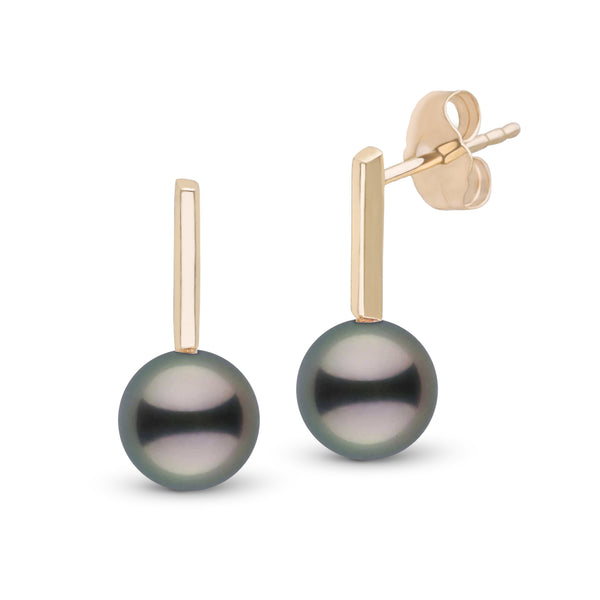
Earrings, pendants, and rings are shown with representative photos since we match and set each one to order. If you’d like a specific overtone or want to choose your exact pearl, just leave a note at checkout, email us for photos, or schedule a virtual appointment to select your pearl in real time.
Our standard Tahitian pearl color is medium-dark with green overtones, the most popular choice. Tahitian pearls also come in shades like peacock, nearly black, silver, and blue. If you’d like a specific color, you can note it at checkout, email us for photos of your exact pearl, or book a virtual appointment to select one in person.


