


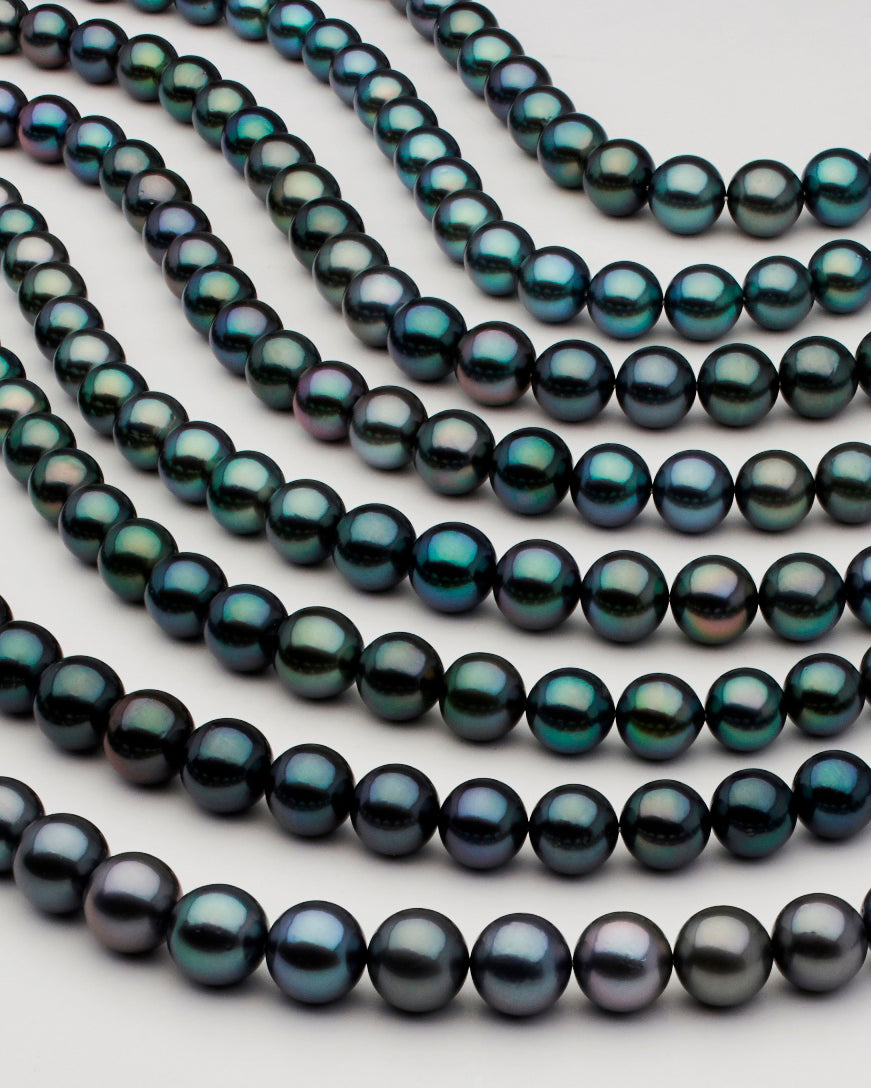
Exotic black pearls from the Pinctada margaritifera or Black-lip pearl oyster, are more commonly known as Tahitian pearls. These pearls are often referred to as black, but have a remarkable color range that covers the spectrum - from light, creamy white and grey, to regal greens, iridescent peacock and deep black. Tahitian pearls are relative newcomers to the pearl world, popularized only as early as the mid-1900s by the efforts of Mr. Robert Wan of Tahiti and his New York-based colleagues.
Unlike the more common pearl types, Tahitian pearls typically have a naturally dark body color. These pearls have become some of the most sought-after, expensive pearls in the world. Because of their vast color range, matching these pearls into a finished strand is an enormous task requiring thousands of loose pearls to create a single strand.
How do they compare to other types of pearls?
Tahitian pearls are considered to be the second most valuable commercially farmed pearls in the world. Unlike black freshwater and black akoya pearls, which have been irradiated or dyed, Tahitians come by their dark color naturally. Tahitian pearls are bead-nucleated, but unlike akoya pearls, the nacre is typically very thick. The thinnest nacre allowed by French Polynesian law for export is 0.8 mm, which is a depth that would be considered, in the akoya world, extremely thick.
The more you know...

What colors, shapes, and sizes are available?
Beautiful Tahitian pearls are among the largest pearls in the world, ranging in size from approximately 8 mm to 18 mm. The only larger commercially harvested pearls today are South Sea. The beauty of Tahitian pearls, however, is not limited to their size, but their incredible array of iridescent colors. Tahitian pearls are the only pearls that have a full color spectrum. Black-lip pearl oysters have a rainbow-like mantle which exhibits all natural colors. These colors are expressed in Tahitian pearls in a magical way with colors shimmering over the surface of some of the best specimens.
Because Tahitian pearls are bead nucleated many of them are round, or near round, with other shapes expressed in drops, baroques, button and circled pearls. When all other factors are equal, round Tahitian pearls are the most valuable.

How rare and valuable are they?
Tahitian pearls were once the rarest, most valuable cultured pearls in the world. They are still much more valuable than freshwater and akoya pearls, but the farming enterprises are no longer relegated to small groups of atolls. This has brought market forces into play, and today, Tahitian pearls are now affordable to a much wider demographic. Fifteen years ago, a perfect strand of Tahitian pearls for $100,000 would have been considered a bargain. Today, these strands are available at PearlParadise.com for around $2 - $4000.

Where do they come from?
Although Tahitian pearls carry the name of the famous Tahiti Island they do not come from Tahiti. Tahiti is the main trading post for atolls that produce Tahitian pearls. Black-lip pearls are farmed in French Polynesia, the Cook Islands, the Micronesian Islands, and even to some extent, Japan, Thailand, and the Philippines, but only those grown in French Polynesia may be called Tahitian pearls.


